


As India enters the era of Artificial Intelligence and digital education, a fundamental question deserves greater attention.
For years, Corporate Social Responsibility (CSR) has played a vital role in improving education across India. Companies have funded classrooms, digital learning platforms, science laboratories, school buses, libraries, and scholarships. These investments have expanded access to education and improved learning environments for millions of children.
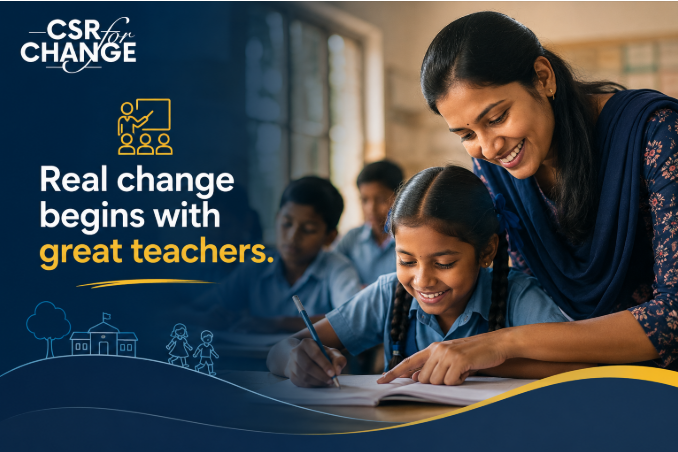
But as India enters the era of Artificial Intelligence and digital education, a fundamental question deserves greater attention.
What creates las
ting impact in rural education?
Is it technology? Infrastructure? Digital content?
Or is it the teacher who brings all these resources to life?
A recent peer-reviewed study published in the International Journal of Latest Technology in Engineering, Management & Applied Science (IJLTEMAS) offers an important perspective. The paper, co-authored by two educators from The Kalgidhar Society, Baru Sahib, argues that technology should strengthen human-centred education rather than replace it. It warns that excessive reliance on digital systems can unintentionally weaken local knowledge, cultural understanding, and the relationships that define meaningful learning.
For CSR leaders, this is more than an academic discussion. It is a strategic question about where future investments will generate the greatest social return.
Infrastructure Enables Learning. Teachers Create It.
Across India, CSR programmes have helped schools acquire computers, smart boards, internet connectivity, and digital learning tools. These are valuable investments, particularly in underserved communities where access has historically been limited.
Yet the effectiveness of every classroom ultimately depends on one person.
The teacher.
Technology can deliver information.
Teachers build understanding.
Technology can personal
ise lessons.
Teachers recognise fear, curiosity, confidence, and potential.
Technology can answer questions.
Teachers inspire children to ask them.
This distinction becomes even more important in rural India, where teachers often serve as mentors, counsellors, and trusted members of the community.
Rural Teachers Create Impact Beyond the Classroom
When we evaluate CSR outcomes, we often focus on measurable indicators such as enrolment, examination results, attendance, or digital access.
But the influence of a high-quality teacher extends well beyond these metrics.
A teacher encourag
es first-generation learners to stay in school.
A teacher convince
s parents that educating daughters is an investment, not an expense.
A teacher introduces scientific thinking, environmental awareness, and responsible citizenship.
A teacher helps children develop confidence to pursue careers that once seemed beyond reach.
The impact does not stop with education.
In many rural communities, teachers become trusted voices on nutrition, hygiene, mental well-being, substance abuse prevention, and healthy lifestyles. Students carry these lessons into their homes, influencing families and strengthening community health.
This is why investments in rural education often produce outcomes that improve healthcare, gender equality, livelihoods, and long-term community resilience.
The Next Frontier for Education CSR
As Artificial Intelligence becomes part of classrooms, CSR strategies must also evolve.
The question is no longer whether schools need technology.
They do.
The question is whether investments are creating the human capacity required to use technology effectively.
Teacher development remains one of the most underfunded areas within education-focused CSR, despite being one of the strongest predictors of student success.
Professional development, leadership training, mentoring, continuous learning, digital pedagogy, and value-based education are not as visible as a newly inaugurated computer lab. They do not generate ribbon-cutting ceremonies or photo opportunities.
Yet their impact lasts for decades.
Every well-trained teacher influences hundreds, sometimes thousands, of students during their career.
Few CSR investments can claim that level of multiplier effect.
A Systems Approach to Rural Development
Rural education cannot be viewed in isolation.
A child who receives quality education is more likely to make informed decisions about health, nutrition, financial literacy, environmental stewardship, and civic responsibility.
An educated girl is more likely to remain in school, marry later, access better healthcare, and contribute to her family’s economic stability.
A confident student is more likely to pursue higher education, secure meaningful employment, and give back to the community.
Education becomes the foundation upon which healthier and more resilient villages are built.
This systems perspective is increasingly important for companies seeking measurable ESG and CSR outcomes that align with multiple Sustainable Development Goals rather than addressing a single issue.
Rethinking What We Fund
Perhaps the most important question every CSR leader should ask is not, “What can we donate?”
It is, “What creates sustainable change?”
Buildings matter.
Technology matters.
Digital access matters.
But none of them reaches its full potential without capable, motivated, and well-supported teachers.
As India continues to embrace Artificial Intelligence and digital transformation, the country’s greatest educational investment may still be the person standing at the front of a rural classroom every morning.
Technology will continue to change how children learn.
Great teachers will continue to shape who they become.
For CSR leaders seeking long-term social impact, investing in teachers is not simply an education strategy.
It is a rural development strategy.
It is a healthcare strategy.
It is a nation-building strategy.
That may be the highest return on investment any education programme can deliver.