October 15, 2026
Despite several contributions, Punjab has often remained outside the mainstream conversation on Corporate Social Responsibility (CSR) Punjab has always...



India’s CSR story has changed dramatically over the past decade.
Corporate Social Responsibility is no longer a peripheral activity. It is now a significant source of social investment, with companies spending tens of thousands of crores every year on education, healthcare, livelihoods, environmental sustainability and rural development.
But a larger CSR pool raises an important question:
Is CSR money reaching the places where the need is greatest, or is it following the places where companies are concentrated?
The answer matters.
Because a school in a metropolitan city and a school in a remote rural district may both require investment, but the consequences of receiving or missing that investment can be very different.
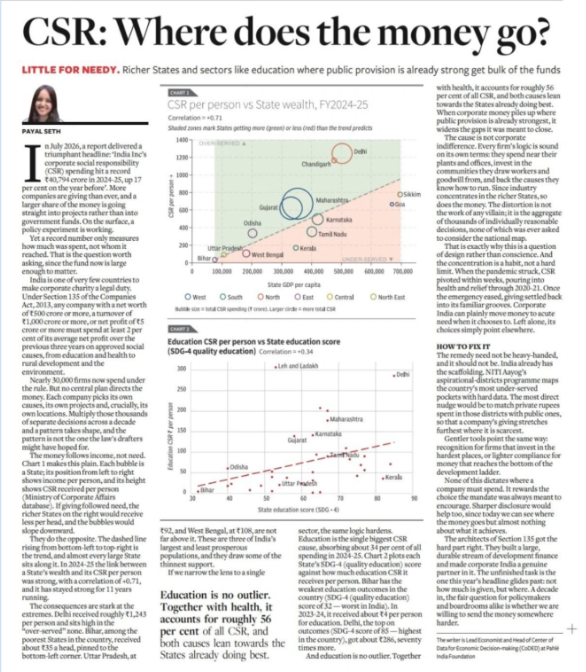
A recent analysis of India’s CSR geography brings this question into focus. Its finding is difficult to ignore: CSR spending per person has a strong positive correlation with state wealth.
The Ministry of Corporate Affairs has also acknowledged the broader issue. Its National CSR eXchange Portal states that CSR has remained largely supply-driven and that there is a geographic skew towards industrialised states, with less-developed states receiving less funding.
This is not an argument against companies investing in the states where they operate.
It is an argument for asking whether corporate presence should determine social investment.
India’s CSR framework was introduced through Section 135 of the Companies Act, 2013.
Companies meeting specified financial thresholds are required to spend at least 2% of their average net profits from the preceding three financial years on eligible CSR activities, subject to the provisions of the law.
The system has created a substantial and increasingly sophisticated pool of private capital for social development.
According to the Ministry of Corporate Affairs, reported CSR expenditure increased from ₹24,965.82 crore in FY2019-20 to ₹34,908.75 crore in FY2023-24.
MCA’s CSR database now provides state-wise, sector-wise and company-wise information, including data for FY2024-25.
The question is therefore no longer whether CSR has become significant.
It has.
The more important question is:
The Ministry of Corporate Affairs currently publishes a “Top 15 States by CSR Funds Received” view. It notes that more than 90% of total CSR spending has been made in these states, with Maharashtra consistently receiving the highest contribution.
There are practical reasons for this concentration.
Companies naturally find it easier to support projects close to:
None of these considerations are unreasonable.
But they create a structural risk.
Corporate geography can begin to look like social-need geography.
It isn’t.
A state with more companies does not necessarily have a proportionately greater need for CSR.
And a district with fewer companies does not necessarily have less need.
This distinction is at the heart of the CSR debate.
Consider what happens when CSR decisions are made primarily through convenience.
A company already has an NGO partner in a major city.
The NGO has established reporting systems.
The CSR team can visit the project easily.
The company’s employees can participate.
The board can see the project.
The annual report can showcase the outcomes.
It is a sensible operating model.
But now consider a rural district several hundred kilometres away.
There may be:
The need may be greater.
The execution may simply be harder.
And when execution is harder, CSR money can move elsewhere.
This creates an uncomfortable cycle:
Less corporate presence → fewer CSR relationships → fewer established projects → less corporate confidence → continued underinvestment.
The very places that need stronger CSR partnerships can therefore remain outside the mainstream CSR ecosystem.
Education is one of India’s largest CSR priorities.
That is understandable.
Education has long-term effects on income, employability, health, gender equality and social mobility.
But simply increasing education expenditure does not guarantee better outcomes.
The analysis that prompted this discussion found a positive but much weaker correlation between education CSR per person and state education performance than the correlation between state wealth and CSR per person.
That distinction is important.
CSR should not be evaluated only by the amount spent.
It should be evaluated by the additional value created by the investment.
A ₹1 crore investment in a school system that already has substantial resources may produce incremental improvements.
The same investment in a resource-constrained rural education ecosystem could potentially address a gap that has remained unresolved for years.
The question, therefore, is not:
Where can we spend ₹1 crore?
It is:
Where can ₹1 crore make the greatest difference?
Punjab is an interesting example in this debate.
The recent newspaper analysis that triggered this discussion does not label Punjab in its charts.
That does not mean Punjab receives the least CSR in India. It would be incorrect to make that claim from the chart alone.
The official MCA database does list Punjab separately and allows CSR expenditure to be examined by state and development sector.
But Punjab’s absence from a national visualisation raises a more useful question:
Punjab is often discussed through its agricultural economy, cities and historical prosperity.
That can conceal the differences within the state.
For a child living in a remote village, the relevant indicators are not the state’s reputation.
The relevant questions are much more immediate:
Can the child access a quality school?
Does the school have a science laboratory?
Is digital learning available?
Can the family afford continued education?
Are teachers adequately supported?
Does the student have access to career guidance?
Can a rural girl continue her education beyond school?
These are the gaps that CSR can help address.
There is a strong case for companies to think beyond the geography of their own operations.
A company headquartered in Mumbai can support rural education in Punjab.
A technology company in Bengaluru can invest in digital education in Rajasthan.
A corporate foundation in Delhi can support healthcare or education in Himachal Pradesh.
A manufacturing company in Gujarat can support a community development programme in Uttar Pradesh.
CSR law does not require companies to limit themselves to their immediate corporate neighbourhood.
More importantly, social impact should not be constrained by the location of a corporate office.
The real opportunity is to create bridges between corporate capital and underserved communities.
India does not necessarily need CSR organisations to compete for a larger pool of money.
It needs better allocation of the money already available.
That requires CSR leaders to add another layer to their decision-making.
Before approving a project, ask:
Look beyond the presence of an NGO or the ease of implementation.
Examine education, health, poverty, gender, livelihoods, infrastructure and other relevant indicators.
A project may be valuable, but the CSR ecosystem should also consider whether a district is already receiving substantial corporate investment or remains largely overlooked.
The strongest CSR projects should address a genuine gap rather than simply add another programme to an already crowded ecosystem.
Under-served geographies should not mean lower standards.
CSR partners need proper governance, financial controls, monitoring, reporting and measurable outcomes.
The strongest projects should build capacity and create durable improvements rather than depend indefinitely on annual grants.
India has spent more than a decade building the infrastructure of CSR.
Companies have CSR committees.
There are annual action plans.
There are reporting requirements.
There is an expanding database of projects and implementing agencies.
The next stage should be more sophisticated.
It should be about CSR intelligence.
That means combining:
Need + geography + implementation capacity + measurable outcomes.
The MCA’s own state and district dashboard is a useful starting point because it recognises the geographic imbalance and provides a framework for looking at CSR beyond company-level spending.
The next step is for CSR leaders to use such information actively when deciding where to invest.
A company does not have to redirect its entire CSR budget away from the places where it operates.
A more practical approach could be to create a deliberate allocation for underserved geographies.
For example:
A CSR portfolio could combine local-area projects with a defined percentage for high-need, under-served districts.
This approach protects the company’s existing commitments while allowing CSR to address gaps that market forces are unlikely to solve.
Companies can also work through established rural networks.
This reduces one of the biggest barriers to geographically distributed CSR: the absence of reliable implementation infrastructure.
The goal should be to make it easier for a CSR team in Mumbai, Delhi, Bengaluru or Gurugram to confidently invest in a rural district where the company has no physical presence.
This is where organisations with long-standing rural networks can play an important role.
The Kalgidhar Society, for example, has built a network of 130 Akal Academies serving nearly 75,000 students across rural areas of Punjab, Haryana, Himachal Pradesh, Rajasthan and Uttar Pradesh. Its official reporting states that 33,906 children currently receive free or subsidised education across the network.
The relevance of such a network to CSR is not simply its scale.
It is the presence on the ground.
A rural CSR project needs more than funding.
It needs schools, teachers, communities, systems, monitoring and institutional continuity.
A long-established rural education network can provide that foundation.
The Kalgidhar Society’s work spans education as well as women empowerment, healthcare and social welfare, giving CSR partners the opportunity to consider longer-term community development rather than isolated interventions.
This is one model.
The broader principle applies across India:
If CSR capital cannot easily reach an underserved geography, the answer may be to build stronger bridges to credible local implementation partners rather than allow that geography to remain underfunded.
This is the conversation that CSRforChange.com wants to encourage.
Not:
“Which NGO should receive our CSR budget?”
But:
“Which social gaps are we currently not reaching?”
That shift changes the starting point.
CSRforChange seeks to bring corporates, CSR leaders and credible implementation organisations closer to projects where additional investment can create meaningful social value.
For The Kalgidhar Society, this includes rural education and community development across North India, where its institutional presence already reaches communities that are often outside conventional corporate CSR networks.
The objective should not be to move CSR money simply because a particular geography has received less.
Underinvestment alone is not a sufficient reason to fund a project.
The stronger case is:
high need + credible implementation + measurable outcomes + relatively limited existing CSR support.
That is where CSR can become genuinely additional.
For the first decade of India’s mandatory CSR framework, one question dominated:
Are companies spending their CSR allocation?
That question remains important.
But it is no longer enough.
The next question should be:
Are we allocating CSR where it can create the greatest additional social value?
And perhaps the most uncomfortable question is this:
If CSR continues to follow corporate concentration, who will invest in the communities that lie outside that map?
There is no simple answer.
But there is a clear opportunity.
India now has a CSR pool large enough to think beyond proximity.
Corporates can continue supporting the communities around their operations while also deliberately reaching places where corporate presence is limited and social gaps remain significant.
Because CSR should not merely follow where the companies are.
If your organisation is reviewing its CSR portfolio for the coming year, consider adding one question to the evaluation framework:
That question may lead somewhere new.
It may lead to a rural school.
A district with limited CSR presence.
A girl who is at risk of dropping out.
A school that needs a science laboratory.
A community that needs digital infrastructure.
Or thousands of children who simply need the opportunity to continue their education.
CSRforChange.com brings together opportunities for corporates seeking credible, outcome-focused CSR partnerships in underserved communities.
The Kalgidhar Society’s rural education network is one such opportunity, with 130 Akal Academies serving nearly 75,000 students across five northern states.
The invitation is simple:
That is where the next chapter of Indian CSR should begin.
Corporate Social Responsibility (CSR) in India is a statutory framework under Section 135 of the Companies Act, 2013 that requires qualifying companies to undertake CSR activities and, subject to the applicable provisions, spend at least 2% of their average net profits from the preceding three financial years on eligible CSR activities.
Not always. The Ministry of Corporate Affairs has itself identified a geographic skew in CSR spending towards industrialised states and noted that less-developed states have received comparatively less funding.
Maharashtra has consistently been the largest recipient of CSR funding. The Ministry of Corporate Affairs’ current state-wise overview shows that the top 15 states account for more than 90% of total CSR spending.
There is not enough evidence to make that claim. Punjab is included separately in the official MCA CSR database. The more important issue is whether rural and underserved communities within states such as Punjab receive adequate CSR investment relative to their social needs.
Companies often invest where they have offices, factories, employees, established NGO relationships and easier monitoring access. These factors can unintentionally create a concentration of CSR in industrialised and corporate-heavy regions.
Rural communities can face gaps in access to quality education, healthcare, digital infrastructure, livelihoods and other essential services. Well-designed CSR investment can help address these gaps when it is supported by credible local implementation and measurable outcomes.
Companies can compare CSR expenditure with indicators such as poverty, education outcomes, healthcare access, gender indicators, rural infrastructure and climate vulnerability. The MCA’s state and district CSR data provides a useful starting point for examining the geographic distribution of CSR spending.
Yes. CSR programmes are not required to be restricted exclusively to the locations where a company has operations. Companies can consider projects in other geographies as part of their CSR strategy, subject to applicable CSR rules and their approved CSR policy and action plan.
A credible partner should have relevant field experience, sound governance, financial controls, appropriate statutory registrations, transparent reporting, measurable outcomes and the ability to monitor projects over the long term.
Companies can support scholarships, school infrastructure, digital learning, science laboratories, teacher development, transportation, renewable energy, vocational education and other interventions, depending on the identified need and the applicable CSR framework.
CSRforChange is a platform focused on connecting corporate CSR intent with credible social-impact opportunities, particularly in areas where additional CSR investment can address significant unmet needs.
CSRforChange Editorial Team
This article is based on publicly available CSR data and analysis from the Ministry of Corporate Affairs and related public sources. The article combines statutory CSR information with field-based observations about rural education and CSR implementation.
Editorial approach: CSRforChange aims to promote evidence-based CSR allocation, transparent partnerships and measurable social impact.
Ministry of Corporate Affairs, Government of India: CSR state and district-wise dashboard. MCA National CSR eXchange Portal
Ministry of Corporate Affairs: CSR data, including state-wise and sector-wise expenditure. MCA CSR Data Portal
Ministry of Corporate Affairs: Corporate Data Management state-wise CSR overview. MCA State-wise CSR Data
Government of India, Press Information Bureau: CSR expenditure reported for FY2019-20 to FY2023-24.
The Kalgidhar Society: Organisational profile and rural education footprint.