

For 38 years, the free medical camps at Baru Sahib have brought specialist doctors, surgeries and medicines to families in the hills who would otherwise travel for days to get treated. On 3rd and 4th October 2026, the 111th camp at Akal Charitable Hospital served more than 1,000 people and performed 22 surgeries free of cost. It is one more step in Kalgidhar Trust, Baru Sahib’s long effort to make rural healthcare in India easier to reach.
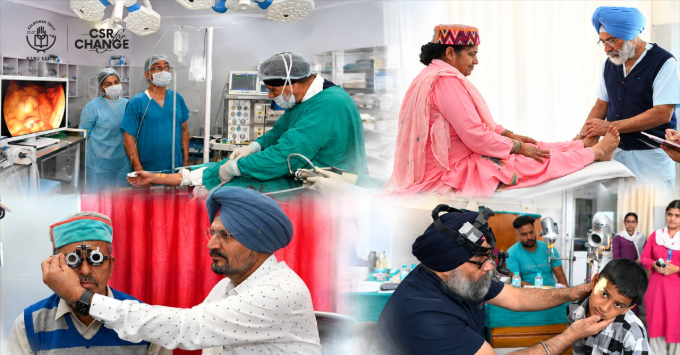
On the morning of 3rd October 2026, the corridors of Akal Charitable Hospital at Baru Sahib, Sirmaur district, Himachal Pradesh, began filling up long before the doctors had settled into their chairs. Some patients had travelled for hours from villages tucked into the hills of Himachal Pradesh. Others had come from Punjab, carrying old prescriptions and reports in plastic folders, hoping that this time someone would have the time to look at them properly.
By the end of the second day, more than 1,000 people had been seen. The 111th Free Medical & Surgical Camp, held on 3rd and 4th October 2026 in association with Akal College of Nursing, Eternal University, recorded 872 OPD consultations and 22 surgeries. These figures tell only part of the story. The rest is about rural healthcare in India, and about a decision taken nearly four decades ago in a small hill village to stop waiting for help to arrive.
Why Free Medical Camps Still Matter in the Hills
For millions of families, rural healthcare in India still begins with a long journey. A specialist may be a full day’s travel away. A routine surgery can mean days of lost wages, transport costs and a stay in an unfamiliar city. Many people put off treatment until a manageable problem turns into a serious one.
When families in these areas look for help, what they usually want is simple. They want a free primary health care NGO or hospital nearby, where a doctor will listen to them without the worry of a bill at the end. The medical camps at Baru Sahib were started to meet exactly that need. Patients receive free consultations, investigations, medicines, specialist care and, where required, surgery, all in one place and much closer to home. For a farmer with a hernia, or a mother who has lived with gallstone pain for months, this can decide whether they get treated or simply keep coping.
About Akal Charitable Hospital, Baru Sahib
The camps are held at Akal Charitable Hospital, a 100-bed multi-specialty hospital in Baru Sahib, Sirmaur district. It is the only fully developed medical centre in the rural belt of the district and draws patients from villages across Sirmaur, Shimla and Solan, many of whom would otherwise have to travel to a city for treatment. In hill areas, where rural healthcare in India is often stretched thin, having a hospital of this size close by changes a great deal for local families.
On a regular day, around 450 patients come to its OPD. The hospital offers general and emergency medicine, surgery, gynaecology and obstetrics, paediatrics, orthopaedics, ENT, eye care, dental care, physiotherapy, psychiatry and de-addiction, along with pathology, X-ray and ultrasound services. Care is provided free or at a nominal cost, so that money never becomes the reason someone goes without treatment. The medical camps grew out of this everyday work, and they bring in visiting specialists to reach even more people over a few concentrated days.
The 111th Camp in Numbers
Over the two days, the camp served more than 1,000 beneficiaries. Doctors carried out 872 OPD consultations and 22 surgeries, including laparoscopic cholecystectomy (gallbladder removal), vaginal hysterectomy, hernia repair, piles and ENT procedures. The team also conducted 87 Bone Mineral Density tests and 30 other procedures and treatments.
Patients could see specialists in Medicine, Surgery, ENT, Eye Care, Orthopaedics, Gynaecology, Gastroenterology, Dental Care, Audiology, and Psychiatry & De-addiction, with diagnostic services available alongside.
Having so many departments under one roof makes a real difference. One of the biggest gaps in rural healthcare in India is access to more than one specialist at a time, and many camps focus on a single concern such as eye check-ups or general screening. At Baru Sahib, a patient who came in for joint pain could have a bone density test, see an orthopaedic specialist and be guided to another department on the same day.
The Psychiatry & De-addiction services deserve a mention too. Mental health and substance use are still rarely discussed openly in many villages. Offering these services at a free camp, alongside everything else, gives people a quieter and less intimidating way to ask for help.
Doctors Who See It as Sewa
More than 20 specialist doctors travelled from different parts of Punjab, Haryana, Chandigarh and Delhi for the camp. Several of them have 20 to 30 years of experience or more. They did not come for payment. They came to offer selfless sewa.
For many of these doctors, the camp has become a “Langar of Healthcare.” In Sikh tradition, langar is the community kitchen where anyone, from any background, sits down and is served with dignity. Bringing that idea into medicine shows how these doctors see their role. They are here to offer quality specialist care, freely, to anyone who needs it, in a place where such care would otherwise be hard to find.
A Reputation Built on Trust
Ask patients why they keep returning to Baru Sahib and most of them talk about trust. For decades, people have travelled long distances here because they know the care is ethical, transparent and need-based. Investigations and treatments are recommended according to genuine clinical requirements, and nothing is added just to increase a bill.
Many families today worry about being over-tested or over-treated, so a reputation like this is hard-earned and easy to lose. Baru Sahib has protected it for 38 years.
The hospital also keeps adding to what it can offer. With services such as laparoscopic surgery and PRP treatment now available, specialised care that once meant a trip to a big city can now be accessed at Baru Sahib itself. For someone who would otherwise go looking for a free primary health care NGO in a distant town, this steady growth in local facilities often decides whether treatment happens at all.
How It Began in 1988
The Medical Camp Initiative began in 1988 under the guidance of Revered Sant Baba Iqbal Singh Ji, the Founder President of The Kalgidhar Trust, Baru Sahib. His concern was practical. At the time, rural healthcare in India was even harder to reach than it is today, and communities in this region faced both geographical and financial barriers to healthcare. Those barriers were not going to disappear on their own.
His vision soon found committed hands. Inspired by the mission, Dr. Davinder Singh Ji and Dr. Neelam Kaur permanently moved to Baru Sahib in 1992, leaving behind the comforts of city life to strengthen healthcare services in this remote region.
Others joined over the years, and many stayed. Doctors such as Dr. Gautam Singh Ji, Dr. G.P. Singh Ji and Dr. Mukesh Chander have remained associated with the mission for decades. Today it has grown into a multidisciplinary team of doctors, nurses, technicians, Akal College of Nursing faculty, students, alumni and volunteers.
The nursing students play an important part. Many of them will go on to work in hospitals and health centres across the region, and the camp gives them early, hands-on experience of what rural healthcare in India really looks like. They see crowded waiting areas, patients with long and complicated medical histories, and how much patience it takes to treat people well under pressure.
ALSO READ: Healing Beyond Borders – Free Medical Camps That Change Lives
A Community-First NGO with a Commitment to Healing
Healthcare has always been close to the heart of The Kalgidhar Trust, Baru Sahib, even though its name is most widely known for providing quality rural education. As a community-first NGO, its work has grown around the needs of the people it serves. Together, The Kalgidhar Trust and Kalgidhar Society run 130 schools and 2 universities, educating more than 75,000 students, many of them from rural families. Through Educate To Save, the Kalgidhar Society’s child sponsorship initiative, supporters can help a child from a rural family receive free or subsidised education.
Healthcare comes from the same commitment. Sant Baba Iqbal Singh Ji believed that a community cannot move forward if its children are not educated and its families cannot reach basic medical care. Even with education at the centre of its work, the Trust has kept its rural healthcare initiatives running without a break. One hundred and eleven camps since 1988 show how seriously that promise has been kept.
Honouring 100 Years of Sant Baba Iqbal Singh Ji
The 111th camp carried special meaning this year. It was dedicated to the 100th Birth Anniversary of Sant Baba Iqbal Singh Ji (1926–2026), observed as “A Life for Humanity.”
As the founding pillar of The Kalgidhar Trust, Baru Sahib, he started work that continues to reach families through schools, universities, healthcare and community service. His centenary was honoured with more than a thousand patients treated and 22 surgeries performed free of cost, which is a fitting way to remember a life spent serving others.
Why Sustained Rural Healthcare Initiatives Matter
A one-off health camp can do real good, but its impact fades once the camp is over. What sets Baru Sahib apart is continuity. Over 111 camps and 38 years, patients have been able to come back for follow-ups, doctors have come to understand the health needs of the community, and trust has built up across generations.
Government programmes and private hospitals both have an important role in rural healthcare in India. Still, long-running, community-rooted rural healthcare initiatives reach many people that neither can easily reach. They work because they are local and consistent, and because they are run by people who genuinely care about the community.
For organisations deciding where their support can make a lasting difference, this kind of consistency counts for a lot. When companies search for the best NGO for CSR in India, a long and steady track record is often what they look for first, and Baru Sahib has nearly four decades of it.
Supporting the Mission Through CSR for CHANGE
The 111th Free Medical & Surgical Camp shows what can happen when a clear vision, dedicated doctors and the trust of a community come together. Keeping this work going, and taking it to more villages, needs more people and organisations to stand with it.
CSR for CHANGE is an initiative that supports the noble cause of Kalgidhar Baru Sahib. It works with companies that want their CSR contribution to create real change in rural India. Through CSR for CHANGE, organisations can support the Trust’s work in quality rural education, community health, women’s empowerment, the environment and disaster relief, including the rural healthcare initiatives that have served families in Himachal Pradesh and Punjab since 1988. Companies can contribute through CSR funding, partner on specific projects, or offer their expertise and volunteer time.
For businesses looking for the best NGO for CSR in India to partner with, supporting Kalgidhar Baru Sahib through CSR for CHANGE means backing work that has been tested over decades and is rooted in genuine service. Every partnership helps a little more care reach the families who need it, and helps strengthen rural healthcare in India village by village.
38 years of service and a century of inspiration have brought the mission this far, and with the right partners, the work of healing will continue.