October 15, 2026
Despite several contributions, Punjab has often remained outside the mainstream conversation on Corporate Social Responsibility (CSR) Punjab has always...


Every year, companies across India set aside funds for social causes through their CSR programmes. Deciding how much to give is usually the easy part. The harder part is choosing a partner who will use the money well and show clear results.
For many companies, the search begins with a simple question: which is the best NGO for CSR funding? There is no single answer. A good partner already works in the communities that need help, stays with a cause for years and can tell you exactly what your support achieved.
In rural India, the needs are often very basic. Many girls from poor families leave school early because their parents cannot afford the cost. When floods or other disasters strike, families can be left without a safe place to live. Help in such areas works best when it is steady and reaches people through an organisation that knows the ground well.
Sangeeta Poly Pack Pvt. Ltd. has given exactly this kind of help. Since 2019, it has worked with Kalgidhar Trust, Baru Sahib, an organisation with long-standing roots in rural communities, to keep girls in school and to rebuild homes after the 2025 Punjab floods. Its CSR funding for education in India, along with its support for women empowerment and flood relief, sets a useful example for other companies.
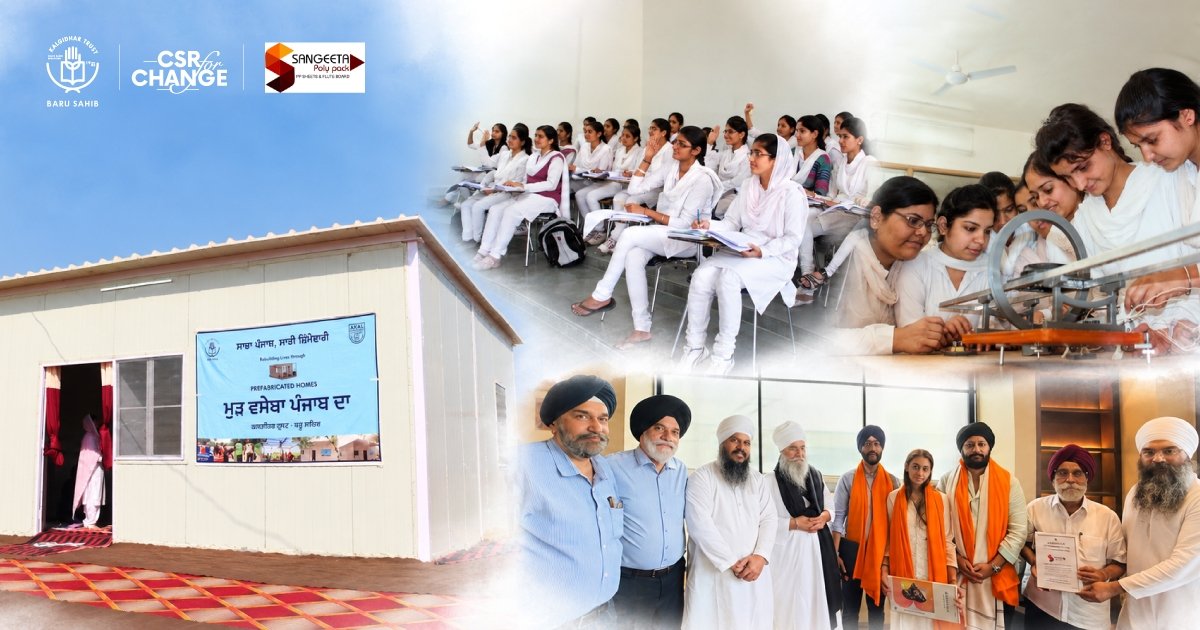
Sangeeta Poly Pack Pvt. Ltd. began its CSR partnership with Kalgidhar Trust, Baru Sahib in 2019. Led by Chairman Harpal Singh and Managing Director Amardeep Arora, the company has supported the Trust’s work through a partnership that now spans seven years, from 2019 to 2026.
Its CSR funding has gone into three areas that matter a great deal in rural India:
– Rural education: helping girls from village backgrounds continue their studies through the Akal Institute of Rural Women Empowerment (AIRWE) and Akal University.
– Women empowerment: giving those girls a clear path from the classroom to a job and financial independence.
– Flood relief: rebuilding safe homes for families hit by the 2025 Punjab floods.
What sets this partnership apart is its long-term nature, something many CSR teams value when they search for the best NGO in India. Because Sangeeta Poly Pack stayed with a partner it knew and trusted, its support could follow students through several years of study, and it could reach flood-affected families when they needed help the most.
Over time, that support has turned into real change: a student’s education, a family’s safe home and a future rebuilt with dignity.
Online lists that rank NGOs can help a CSR team build a shortlist. When it comes to the final decision, though, most CSR teams end up asking some version of the same four questions.
Kalgidhar Trust, Baru Sahib answers the first question through its reach. Together with Kalgidhar Society, it runs 130 schools and 2 universities, educating more than 75,000 students. The work grew from the vision of Sant Baba Iqbal Singh Ji, the founding pillar of Kalgidhar Trust, Baru Sahib, and today the Trust is widely known as an NGO for rural education in India.
The other three questions are best answered through results. Sangeeta Poly Pack’s partnership with the Trust gives a clear example: seven years of support for girls’ education, help for families hit by the 2025 Punjab floods, and outcomes recorded by name for every girl and every family. The sections below look at each of these, and show why a record like this counts for more than size alone when a company is choosing the best NGO for CSR funding.
For a girl growing up in a village, the gap between finishing school and earning a living can be wide. Fees are one hurdle. Long journeys, the cost of food and pressure at home to stop studying are others, and any one of them can end an education early.
Sangeeta Poly Pack directed its CSR funding for education in India towards the Akal Institute of Rural Women Empowerment (AIRWE), run by Kalgidhar Trust, Baru Sahib. Through this programme, eight girls received support that covered far more than tuition:
The second point is easy to overlook. A hostel bed and regular meals sound basic. For a student from a struggling rural household, they can be the reason she stays in school at all.
Four of the eight have gone on to higher education at Akal University, with scholarship support made possible through Sangeeta Poly Pack’s CSR funding: Navjot Singh, Sanjana Pawar, Puja and Durga. Scholarship support keeps a university degree within reach for students whose families could not otherwise manage the cost.
Higher education gives a student the confidence to choose what comes next. For a girl from a village, that choice might be a career, further study or a role in her own community.
This is what many companies hope for when they set aside CSR funding for education in India. The support does not stop at admission. It stays with the student until she can stand on her own feet. An organisation that already runs schools and hostels in villages is well placed to give this kind of long-term support. Individual donors can back a child’s schooling in a similar way through Educate To Save.
Of the eight girls supported through Sangeeta Poly Pack’s CSR funding, four are now financially independent. This figure carries weight because it is specific. These are four named girls whose progress can be clearly seen and verified.
Satnam Kaur and Meena Rani completed their graduation and became school teachers. A girl who once needed help to keep studying now helps other children learn, and the children in her classroom now benefit from the same kind of support that once helped her.
Kiranpal Kaur and Lovepreet Kaur are also financially independent today. They earn their own living and make their own decisions about what comes next.
The path these girls followed is a simple one:
Each step depends on the one before it. Take away the boarding, or end the scholarship a year early, and the chain can break well before a job is in sight.
Parents looking for the best NGO for girl education in India usually want to know where the girls end up after their studies. Companies deciding where to direct their CSR funding ask the same question. Awareness drives and short workshops have their place, but a girl who now earns a salary as a teacher is proof that is far easier to verify.
This is where this part of the partnership has made the biggest difference. Years of study turned into paid work, and paid work has given these girls the freedom to make their own choices. For companies looking for the best NGO for women empowerment, results like these are worth a close look.
When floodwater moved through parts of Punjab in 2025, many families lost far more than crops. Walls cracked, foundations weakened, and houses that had sheltered families for years were suddenly unsafe to sleep in.
This was the point where a long relationship proved its value. In 2025–26, Sangeeta Poly Pack made its largest commitment to the partnership so far and directed it entirely towards flood rehabilitation. Kalgidhar Trust, Baru Sahib carried out the work on the ground.
The approach followed three clear steps: assess, rebuild, rehome. Each damaged house was first checked for safety. Where a home could not be lived in, it was rebuilt, and the family then moved back into a secure and dignified space.
Dharam Singh’s home was left unsafe by the floods. His household was left not knowing where they would live, or for how long.
Through the rehabilitation work funded by Sangeeta Poly Pack, the family now lives in a safe, dignified home. For the family, it has meant moving from uncertainty to the security of a safe home.
Surjit Singh and Gurpreet Singh both saw their homes damaged by floodwater. Today each family lives in a safe, rebuilt house.
Mahil Singh, Karnail Singh and Sukhbir Singh went through the same ordeal. For each of them, the rebuilt home is a safe place to begin again.
Six families may look like a small number next to the size of the 2025 floods. For the people inside those six homes, it is the difference between living in fear of the next heavy rain and planning for the season ahead.
Any NGO for disaster relief can hand out food and blankets in the first week. Rebuilding a house takes months, and it needs a partner who stays involved long after the first wave of help. Because Sangeeta Poly Pack had already worked with Kalgidhar Trust, Baru Sahib for years, there was trust in place to move quickly. Companies planning CSR support for disaster response should look for this kind of long-term commitment.
Between 2019 and 2026, Sangeeta Poly Pack’s CSR funding reached three very different needs. In plain terms, here is what it achieved as recorded in Sangeeta Poly Pack’s CSR Impact Report.
Every figure here comes with names attached, and that makes the record easy to trust. For companies interested in girls’ education, the AIRWE result stands out: half of the girls supported are now financially independent. Two teachers and two other independent earners may sound like a modest list. It is still the kind of proof CSR teams expect when they choose the best NGO for women empowerment.
Chairman Harpal Singh and Managing Director Amardeep Arora have kept Sangeeta Poly Pack’s support with one partner whose work is recorded student by student and family by family. That gives the company a clear story to tell its board when explaining why it chose this partner.
Companies searching for the best NGO in India soon realise that no single organisation suits every business. A manufacturer with roots in Punjab may care most about its own region. Another firm may want to focus only on girls’ schooling. What this partnership offers is a way of judging partners, more than a name to copy.
The same thinking applies to women empowerment. Training numbers and event photos tell only part of the story. Girls who go on to earn their own income tell the rest.
There is no universal answer to which organisation is the best NGO for CSR funding. Being well known matters far less to a CSR team than being able to point to a teacher in a classroom or a family in a rebuilt home. For Sangeeta Poly Pack, the answer came from seven years of results it could check.
Eight girls now have a stronger start in life, and two of them are teachers today. Six families who lost safe shelter in the 2025 floods have homes again. None of this happened in a single year. It came from Sangeeta Poly Pack’s CSR funding, given over seven years under the leadership of Chairman Harpal Singh and Managing Director Amardeep Arora, and from the company’s trust in Kalgidhar Trust, Baru Sahib to put that support to work on the ground.
Kalgidhar Trust, Baru Sahib and CSR for CHANGE thank Sangeeta Poly Pack for standing with these girls and families, and for showing other companies what long-term CSR support can achieve.
CSR for CHANGE is an initiative supporting the noble cause of Kalgidhar Trust, Baru Sahib. It helps companies direct their CSR support towards rural education, women empowerment and disaster relief, with results reported clearly.
If your company would like to follow Sangeeta Poly Pack’s example and is looking for the best NGO for CSR funding to match its own priorities, the CSR for CHANGE team can walk you through current programmes and partnership options. Visit csrforchange.com to start the conversation.
CSR stands for Corporate Social Responsibility. It is a company’s commitment to give back to society through work in areas such as education, healthcare, the environment and disaster relief. In India, CSR is also a legal duty for larger companies under Section 135 of the Companies Act, 2013.
CSR funding is the money a company sets aside for social projects as part of its CSR policy. Under Indian law, companies that meet certain size or profit limits must spend at least 2% of their average net profit from the previous three years on approved activities. Many companies give this funding to trusted NGOs that carry out the work on the ground.
It is a long-term partnership that began in 2019. Under the leadership of Chairman Harpal Singh and Managing Director Amardeep Arora, Sangeeta Poly Pack Pvt. Ltd. has supported the work of Kalgidhar Trust, Baru Sahib through its CSR funding for seven years, from 2019 to 2026.
The funding has gone into three areas: rural education, women empowerment and flood relief. It has helped eight girls from rural backgrounds continue their studies, and it has helped six families affected by the 2025 Punjab floods move into safe, rebuilt homes.
Sangeeta Poly Pack directed its CSR funding for education in India to the Akal Institute of Rural Women Empowerment (AIRWE), run by Kalgidhar Trust, Baru Sahib. Eight girls received support for their studies, along with boarding and meals, so that cost and distance did not force them to leave school.
Four of the eight girls are now financially independent. Satnam Kaur and Meena Rani completed their graduation and became school teachers, while Kiranpal Kaur and Lovepreet Kaur now earn their own living. For companies looking for the best NGO for women empowerment, results like these show how education can lead to a steady income.
Navjot Singh, Sanjana Pawar, Puja and Durga have gone on to higher education at Akal University with scholarship support from Sangeeta Poly Pack’s CSR funding. The scholarships help keep a university degree within reach for girls whose families could not otherwise manage the cost.
Kalgidhar Trust, Baru Sahib also works as an NGO for disaster relief, and in 2025–26 Sangeeta Poly Pack directed its CSR funding towards flood rehabilitation. The Trust followed three steps: assess, rebuild, rehome. The families of Dharam Singh, Surjit Singh, Gurpreet Singh, Mahil Singh, Karnail Singh and Sukhbir Singh now live in safe, rebuilt homes.
It shows the value of staying with one trusted partner over many years. Sangeeta Poly Pack’s support followed students through their studies and reached families when the floods struck. Every result is linked to a named girl or family, so a company can see exactly what its support achieved.
Companies can connect with CSR for CHANGE, an initiative supporting the noble cause of Kalgidhar Trust, Baru Sahib. The CSR for CHANGE team can suggest programmes in rural education, women empowerment and disaster relief that match a company’s own CSR goals.
Wonderful initiative! Supporting communities through education, empowerment, and relief efforts is a step towards a better and more inclusive future.
A thoughtful CSR initiative that addresses some of the most important social needs. Such contributions are essential for creating lasting change and strengthening communities. Congratulations to the team!