November 25, 2026
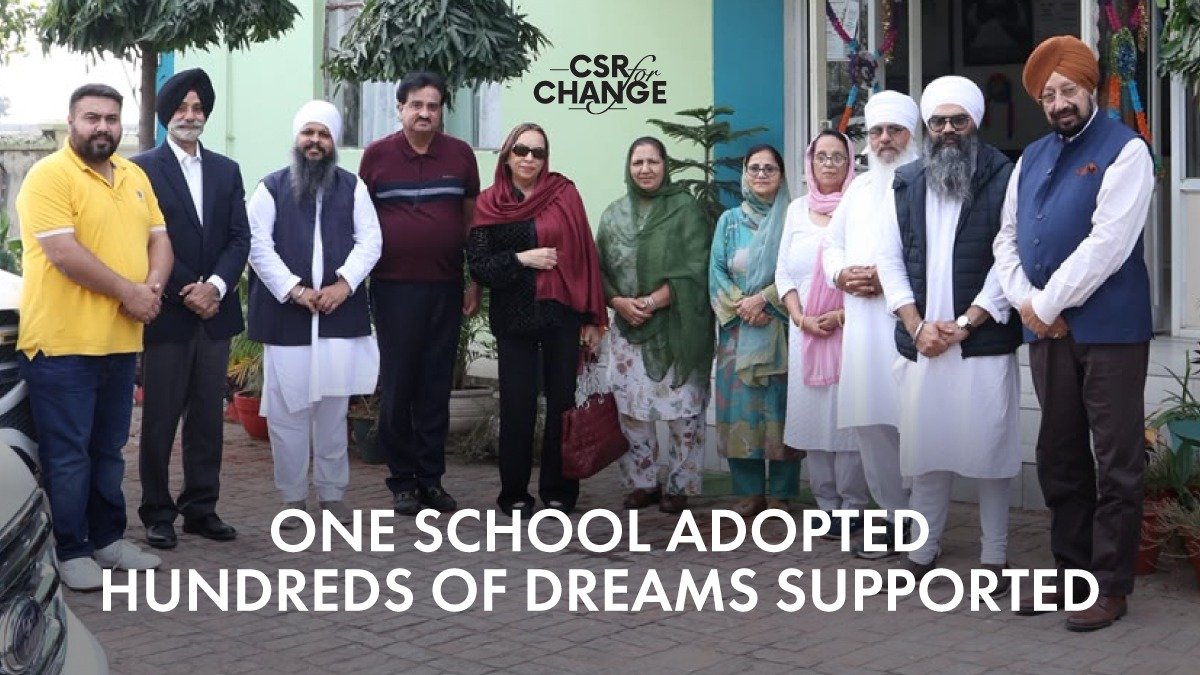
The Vivek Chadha Foundation, a UK charity led by its chairperson G.S. Chadha, has adopted Akal Academy Manoli Surat,...


Many companies in India do not manage to spend their full CSR budget within the financial year. The reasons are usually practical. A school building takes longer than planned, a partner NGO needs a few months to begin work, or profits come in late and leave little time to plan. The money left over at the end of the year is known as the unspent CSR amount, and the Companies Act is very clear about what must happen to it.
The amounts involved are large. Among NSE-listed companies alone, ₹3,223 crore was moved into special accounts for future CSR spending in FY 2024-25. Companies still have to use this money within strict timelines, and a missed deadline can lead to heavy penalties for the company and its officers. Getting the rules right protects the business and makes sure the money reaches the people it was meant for.
An unspent CSR amount is the part of a company’s required CSR spending that is still unspent when the financial year ends. The required amount comes from the CSR law itself.
Section 135 of the Companies Act, 2013 applies to every company that, in the previous financial year, had a net worth of ₹500 crore or more, a turnover of ₹1,000 crore or more, or a net profit of ₹5 crore or more. Such a company must spend at least 2% of its average net profit of the last three financial years on CSR activities listed in Schedule VII of the Act.
For example, if a company’s CSR obligation for the year is ₹10 crore and it spends ₹7 crore by 31 March, then ₹3 crore is unspent.
This money does not go back into the company’s general funds. The law decides where it must go, and the answer depends on one question: is the money linked to an ongoing project or not? Earlier, under the old “comply or explain” approach, a company could simply give reasons in its board report for not spending. The Companies (Amendment) Act, 2019 changed this by bringing in compulsory transfer rules for unspent CSR funds.
An ongoing project is a multi-year CSR project with a timeline of up to three years, not counting the financial year in which it started. A project first planned for one year can also become ongoing if the board extends it for a reasonable cause. As per the Ministry of Corporate Affairs FAQs on CSR, the project must have started within the financial year to be called ongoing, and its timeline cannot be stretched beyond the permitted limit.
Typical ongoing projects include building classrooms or hospital wards, multi-year scholarship programmes, solar installations and skill training batches that run for more than a year. A project does not need to involve construction to qualify. What matters is that it was planned as a multi-year commitment and approved by the board.
Unspent money that does not relate to any ongoing project follows a separate route, and the deadlines for the two are very different.
Section 135(5) and 135(6) set out where the money goes and by when. The table below sums up these timelines.
| Situation | Where the money goes | Deadline |
| Unspent amount linked to an ongoing project | Unspent CSR Account in a scheduled bank | Within 30 days from the end of the financial year |
| Money in the Unspent CSR Account still not used after three financial years | A fund listed in Schedule VII | Within 30 days from the end of the third financial year |
| Unspent amount not linked to any ongoing project | A fund listed in Schedule VII | Within six months from the end of the financial year |
Schedule VII funds include the PM CARES Fund, the Prime Minister’s National Relief Fund, Swachh Bharat Kosh and the Clean Ganga Fund. For FY 2025-26, which ended on 31 March 2026, a company had to move the ongoing-project portion to its special account by 30 April 2026 and the remaining portion to a Schedule VII fund by 30 September 2026. The MCA FAQs also make it clear that during those six months, the company cannot spend the portion not linked to an ongoing project on any CSR activity. It must go to the fund.
An unspent CSR account is a special bank account that a company opens in a scheduled bank to hold the unspent money of its ongoing projects. It works like a locked box for CSR. The money inside can be used only for the company’s ongoing CSR projects, and not for any general purpose of the company.
A few points from the MCA FAQs are worth noting:
The process is simple, but it has to be completed well before the 30-day deadline.
Money moved into the account must be spent on the ongoing project within three financial years from the date of transfer. Whatever remains at the end of the third year must go to a Schedule VII fund within 30 days. Each year’s annual CSR report shows the balance carried from earlier years, how much of it was spent during the year and what is still left.
Here is how it works with simple numbers. Suppose a company moves ₹5 crore into its special account for FY 2023-24 and spends ₹2 crore each in FY 2024-25 and FY 2025-26. The last ₹1 crore must be used by 31 March 2027. If any of it is still left, it must reach a Schedule VII fund by 30 April 2027.
Any income earned from CSR money also stays within CSR. Under the FAQs on the government’s CSR portal, surplus such as interest earned on CSR funds can be used only for CSR purposes.
CSR defaults are now civil wrongs and not criminal offences. Even so, the penalties are steep. Under Section 135(7), a company that fails to transfer the amount pays twice the amount it should have transferred or ₹1 crore, whichever is less, and every officer in default pays one-tenth of that amount or ₹2 lakh, whichever is less.
These penalties are actively applied. In one case, the Registrar of Companies, Hyderabad penalised an IT company in February 2023 for failing to move ₹42,09,263 into its special account by 30 April 2021, the deadline for FY 2020-21. The money was moved only on 30 September 2021. The company was fined ₹84,18,526, which is twice the unspent amount, and each of its four officers in default was fined ₹2 lakh, taking the total to ₹92,18,526. Cases like this show that regulators do check unspent CSR transfers in annual filings.
Good planning is the simplest way to keep the leftover amount small and well used. The steps below help companies stay on the right side of the law.
The treatment of unspent CSR amount in the books follows a simple principle. Once the financial year ends, the company has a legal duty to transfer the unspent money. So the full CSR obligation is shown as an expense in the profit and loss statement, and the unspent part is shown as a liability (provision) in the balance sheet until it is transferred. This applies to both ongoing and other projects.
ICAI’s revised Technical Guide on accounting for CSR expenditure explains this in detail, including CSR spent in kind and excess spending. Companies should follow it along with their auditors.
Unspent money has to be reported in several places, so regulators, shareholders and the public can see how it is being handled.
Regulators use these filings to check compliance with the unspent CSR provisions of the Act, so the numbers in each place must match.
Two developments in 2026 are worth knowing.
First, on 27 May 2026, the MCA notified amendment rules that allow companies to spend CSR money through Zero Coupon Zero Principal (ZCZP) instruments issued by non-profits listed on the Social Stock Exchange. Companies can use this route for up to 10% of their CSR spend in a year. Under this route, the non-profit must complete the project within three financial years, and any money left over goes to a Schedule VII fund when the instrument ends.
Second, the Corporate Laws (Amendment) Bill, 2026 proposes extending the transfer window for ongoing projects from 30 days to 90 days and raising the net profit threshold from ₹5 crore to ₹10 crore. The Joint Parliamentary Committee presented its report on the Bill on 3 August 2026. As of November 2026, the Bill has not been passed, so the 30-day rule still applies.
The unspent CSR amount for ongoing projects is the only part that can stay with an implementing agency. Everything else must go to a Schedule VII fund. This makes the choice of partner at the planning stage very important. Projects in rural education, healthcare and the environment often run over several years, so they suit the ongoing project format well. This matters even more in states such as Punjab, which receives a small share of CSR funding in India.
CSR for CHANGE is an initiative supporting the noble cause of The Kalgidhar Society and Kalgidhar Trust, Baru Sahib. Together, they run 130 rural schools, known as Akal Academies, and 2 universities that educate more than 75,000 students. The Akal Academies model was also studied by IIM Ahmedabad in a case study later added to the Harvard Business Review case collection. Companies can plan multi-year CSR projects in these areas:
Both organisations are registered on the National CSR Portal and hold 12A, 80G and FCRA registrations. In 2023, The Kalgidhar Society, Baru Sahib also became the first non-profit from Himachal Pradesh and Punjab to be listed on the BSE Social Stock Exchange. Progress is reported openly, as in this five-year review of their rural education work. Companies can request a project proposal to match their CSR plan and budget.
The rules around unspent money are strict but easy to follow once they are clear. Money linked to an ongoing project goes into a special account within 30 days and must be spent within three years. Money not linked to any ongoing project goes to a Schedule VII fund within six months. Late transfers invite penalties for both the company and its officers.
The best protection is early planning, quarterly reviews and reliable implementing partners. When the unspent CSR amount is handled well, it can fund long-term work in schools, hospitals and villages. For companies looking for such long-term projects, CSR for CHANGE can help plan rural education, healthcare and environment programmes that fit the ongoing project rules.
If the money is linked to an ongoing project, transfer it to the company’s Unspent CSR Account within 30 days from the end of the financial year. If it is not linked to any ongoing project, transfer it to a Schedule VII fund within six months from the end of the financial year.
No. The MCA has clarified that this money cannot be spent on any CSR activity during those six months. It must be transferred to a Schedule VII fund.
No. One account is opened for each financial year, and it can cover all the ongoing projects of that year.
The balance must be transferred to a Schedule VII fund within 30 days from the end of the third financial year.
Only the portion linked to an ongoing project approved by the board can be spent through an implementing agency registered with the MCA. The rest must go to a Schedule VII fund.
No. It is now a civil default, but it attracts monetary penalties for both the company and every officer in default.
It is a special account that a company opens in a scheduled bank to hold the unspent money of its ongoing CSR projects. The money can be used only for ongoing projects, within three financial years from the date of transfer.
FY 2026-27 ends on 31 March 2027. The ongoing-project portion must reach the company’s special account by 30 April 2027, and the rest must go to a Schedule VII fund by 30 September 2027. These dates will change only if the proposed 90-day window becomes law.
No. Any surplus from CSR activities, including interest, cannot become business profit. It must be put back into the same project, moved to the special account for ongoing projects, or sent to a Schedule VII fund within six months of the end of the financial year.
Yes. If a company spends more than its required amount, the excess can be set off against its CSR obligation for up to the next three financial years, with a board resolution. Any surplus from CSR activities does not count as excess spending.
Yes. Even a company whose CSR obligation is small enough that it does not need a CSR committee must follow the same rules for transferring unspent money.
The Vivek Chadha Foundation, a UK charity led by its chairperson G.S. Chadha, has adopted Akal Academy Manoli Surat,...